Shopify Template vs Custom Theme: Which Should Your Store Use?
Kyle Andes
Start with a template if you're under roughly $5,000 a month in revenue, and move toward custom when the template starts costing you sales you can measure. That's the whole framework. The rest of this article is about how to tell which side of that line you're on, from a developer who makes money building custom themes and will still talk you out of one you don't need.
What you actually get with a template
Premium Shopify themes in 2026 are genuinely good. For $180 to $400 you get responsive layouts, OS 2.0 sections, accessibility basics, and updates maintained by a theme studio with thousands of customers stress-testing every release.
A template is the right call when:
- You're validating. Pre-revenue or early revenue, your problem is traffic and offer, not theme architecture. A custom build now is premature optimization.
- Your catalog is standard. Physical products, normal variants, conventional purchase flow. Templates are literally designed for you.
- Speed to launch matters more than differentiation. A template store can be live in days.
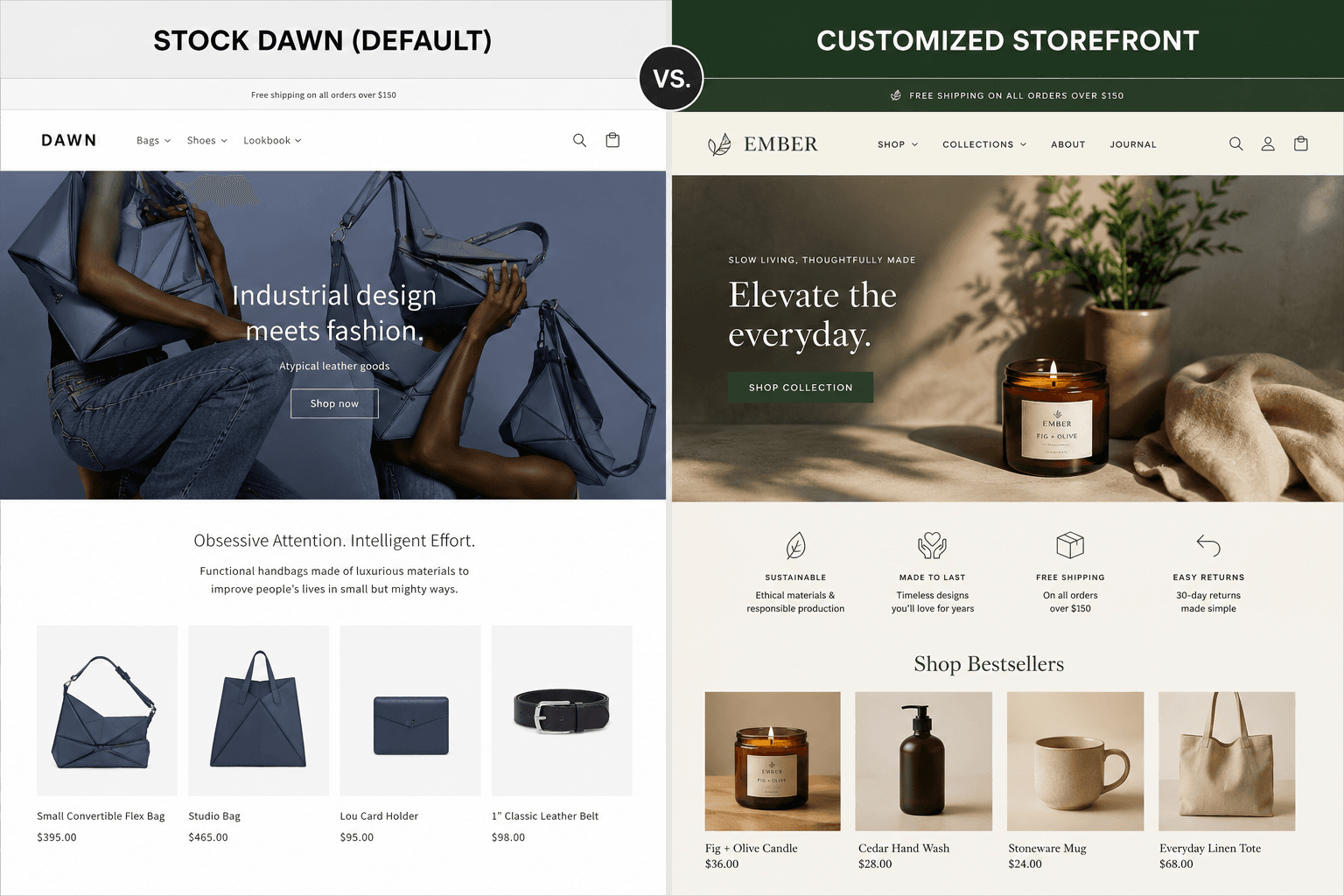
The honest limitation isn't looks. A good developer can restyle a template heavily. The limitations are structural: how product data flows, what the cart can do, how sections compose. You feel them as "the theme won't let us."
The signals it's time for custom
I tell clients to move when at least two of these are true:
- You're fighting the theme weekly. Every merchandising idea needs a workaround, an app, or a developer hour. App stacks especially: each one adds scripts, monthly fees, and another point of failure.
- Mobile speed is measurably hurting you. Templates plus 10 apps routinely produce 6+ second mobile loads. If your Lighthouse mobile score is under 50 and your paid traffic is mostly mobile, you're paying an invisible tax on every ad click.
- Your conversion rate trails your category. If you're driving qualified traffic and converting under roughly 1.5 percent on a standard catalog, the purchase path itself is usually part of the problem.
- Your brand is the moat. When customers can buy similar products elsewhere, the experience is the differentiator, and template sameness actively works against you.
The middle path most stores should take
The template vs custom framing hides the option most growing brands actually need: a semi-custom build. Keep the battle-tested foundation (often Shopify's free Dawn), rebuild the surfaces customers touch: homepage, product page, collection browsing, and a library of flexible custom sections.
You get custom where it earns money and boring reliability everywhere else, at $2,500 to $8,000 instead of $15,000. I've written a full cost breakdown in How much does a custom Shopify theme cost in 2026?
A quick decision table
| Your situation | My recommendation |
|---|---|
| Pre-launch or under $5k/mo | Premium template, lightly customized |
| Growing, fighting the theme, app-heavy | Semi-custom build |
| Strong brand, standard catalog | Semi-custom build |
| Unusual product model, configurators, heavy content | Fully custom |
| International, multi-storefront, extreme performance needs | Custom or headless |
The mistake to avoid in either direction
The most expensive path is the zigzag: buy a template, pay three different freelancers to hack it over two years, accumulate 14 apps, then pay for a custom build anyway plus an untangling fee. If you can see custom coming in your next 12 months, skip the intermediate hacking and put that budget into the real build.
FAQ
Can a developer make a template look custom? Visually, mostly yes. Structurally, no. Styling is cheap to change; data flow and page architecture are not.
Will switching themes hurt my SEO? Not if it's done properly: URLs don't change on Shopify, and a competent developer preserves your metadata, structured data, and redirects. Speed improvements usually help rankings.
Can I keep my template and just fix speed? Sometimes. App cleanup and image/script optimization can cut load times significantly. There's a ceiling, but it's a worthwhile first step, and much cheaper.
Not sure which side of the line you're on? Book a discovery call and bring your store URL. I'll tell you honestly if you don't need me yet.

Kyle Andes
I design and build business websites, Shopify stores, and custom web applications. Building my own product, LETPass, shapes how I approach client work: understand the problem, make clear decisions, and keep improving what matters.